
Sep . 14, 2025 08:40 Back to list
Delicious & Crispy Prawn Crackers - Perfect Snack
Introduction to Advanced Prawn Cracker Production Systems
In the rapidly evolving food processing sector, the demand for high-efficiency, reliable, and hygienic manufacturing solutions is paramount. This is particularly true for specialized snack foods like Prawn Crackers, a globally popular delicacy. Our discussion centers on the industrial-grade machinery and integrated systems designed to optimize the production of these distinctive snacks. From raw material handling to final packaging, modern automated systems are transforming traditional methods, ensuring consistent quality, scalability, and cost-effectiveness for manufacturers. The advancements in engineering, material science, and process control are crucial in meeting the stringent demands of the global food market.
The technological evolution in food manufacturing equipment is driven by a need for enhanced productivity, reduced operational costs, and adherence to strict international food safety standards. For operations focusing on such specialty snacks, this translates into precision machinery capable of handling diverse ingredients, achieving uniform product consistency, and minimizing waste. The focus extends beyond mere production to encompass complete lifecycle support, including system integration, maintenance, and technological upgrades, thereby maximizing return on investment for food processing enterprises.
Industry Trends and Market Dynamics for Prawn Cracker Production
The global market for snack foods, including varieties similar to traditional Prawn Crackers, continues its robust growth trajectory, propelled by changing consumer lifestyles, increasing disposable incomes, and a penchant for exotic and convenient food options. This expansion creates significant opportunities for manufacturers equipped with advanced production capabilities. Key industry trends influencing the manufacturing sector for such products include:
- Automation and Robotics: Increasing adoption of automated systems to reduce manual labor, enhance precision, and improve hygiene standards across all processing lines. Robotics are being integrated for tasks such as ingredient handling, product transfer, and packaging.
- Sustainable Manufacturing: A growing emphasis on energy-efficient equipment, waste reduction, and eco-friendly packaging solutions. Manufacturers actively seek machinery that minimizes water, energy consumption, and raw material waste, contributing to lower environmental impact and operational costs.
- Ingredient Versatility: Demand for production lines capable of processing a wider range of raw materials, including alternative flours, diverse protein sources, and various flavoring agents, to cater to evolving dietary preferences and expanding market segments (e.g., gluten-free, vegan options).
- Food Safety and Traceability: Implementation of advanced sensors, real-time monitoring, and data management systems for critical control points. This ensures stringent compliance with international food safety regulations such as HACCP (Hazard Analysis and Critical Control Points) and GFSI (Global Food Safety Initiative) benchmarks.
- Customization and Flexibility: Modular equipment designs that allow for quick changeovers and the production of various product sizes, shapes, and flavors from a single, adaptable line, offering manufacturers significant agility in response to market demands.
Market research indicates a steady compound annual growth rate (CAGR) for the global snack food market, with Asian and emerging markets being significant drivers. This sustained growth fuels the need for sophisticated, high-capacity production machinery, making investment in advanced manufacturing systems a strategic imperative for competitive advantage and long-term success.
Detailed Manufacturing Process Flow for Industrial Prawn Cracker Production Systems
The production of industrial Prawn Crackers involves a multi-stage process, meticulously engineered to ensure quality, consistency, and efficiency. Our advanced systems integrate state-of-the-art components, employing sophisticated manufacturing processes and adhering to rigorous testing standards.
Key Stages and Technologies:
1. Raw Material Preparation
High-grade tapioca flour, fresh prawn paste (or powder), water, and precise seasoning agents are sourced. Ingredients undergo initial quality checks for moisture content, purity, and microbial load, conforming to FDA and ISO 22000 standards. Automated weighing and mixing systems ensure exact proportions for optimal dough consistency, often incorporating shear mixers to achieve homogeneity.
2. Dough Extrusion and Steaming
The mixed dough is fed into high-pressure extrusion machines. These extruders, often featuring precision-engineered components produced via CNC machining for extreme dimensional accuracy and wear resistance, form the dough into uniform logs. These logs are then transferred to continuous steaming chambers, where they are cooked uniformly under controlled temperature (e.g., 90-100°C) and humidity, ensuring proper gelatinization and texture development for expansion.
3. Slicing and Drying
After controlled cooling to optimize material properties, the gelatinized logs are fed into high-speed slicers. These precision blades, often laser-cut and hardened for durability and sharpness, produce uniformly thin crackers (typically 1-2 mm thickness). The sliced crackers then enter multi-zone drying tunnels, where controlled airflow, temperature, and humidity reduce moisture content to extend shelf life, prevent microbial growth, and enhance crispness upon frying.
4. Frying and Seasoning
Dried crackers are transferred to continuous deep-fat fryers, maintained at optimal temperatures (e.g., 170-190°C) for rapid expansion and desired crispness. Post-frying, excess oil is removed through advanced de-oiling mechanisms. An automated seasoning drum or vibrating conveyor system applies a uniform coating of flavor enhancers, ensuring every cracker meets taste and visual specifications. Frying oil quality is continuously monitored and filtered.
5. Cooling and Packaging
Cooled crackers (to ambient temperature) are conveyed to multi-head weighing and vertical form-fill-seal (VFFS) packaging machines. Integrated inspection systems, including metal detectors and checkweighers, ensure product safety and accurate net weight, rejecting any out-of-spec products. Packaging materials comply with food-grade standards and often feature nitrogen flushing for extended freshness and prevention of oxidation.
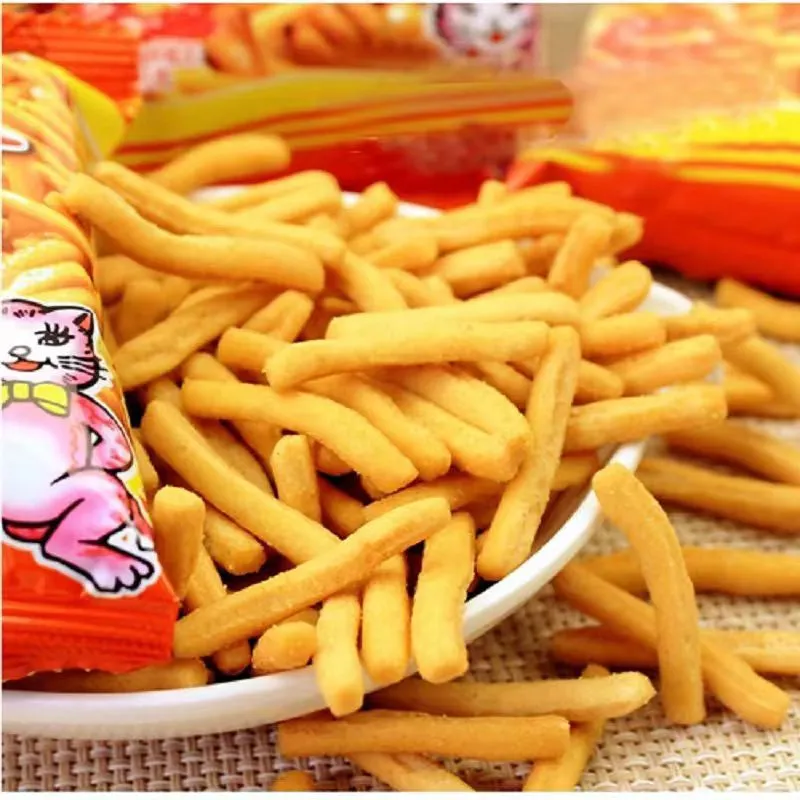
Our systems utilize components manufactured from high-grade food-grade stainless steel (e.g., SUS304, SUS316L), ensuring superior corrosion resistance, ease of cleaning, and hygiene. Critical parts, such as extruder dies and slicer blades, are often produced using advanced CNC machining and specialized heat treatments for unparalleled precision, durability, and longevity, ensuring a service life exceeding 15 years with proper maintenance. Testing standards like ISO 9001 for quality management systems and ANSI standards for machine safety are rigorously applied throughout the design, manufacturing, and commissioning phases.
Target industries include large-scale food manufacturing, dedicated snack food production facilities, and catering suppliers seeking efficient, high-volume production of these popular snack items. In typical application scenarios, these systems demonstrate significant advantages such as energy saving through optimized heating and drying cycles, reduced labor costs via extensive automation, and superior product consistency, leading to higher market acceptance and brand loyalty.
Technical Specifications of Prawn Cracker Production Systems
Our industrial production lines for Prawn Crackers are engineered with advanced technical parameters to ensure optimal performance, reliability, and food safety. These systems integrate cutting-edge control technology with robust mechanical design to maximize uptime and product quality. The following table outlines typical specifications for a medium-to-large scale system:
Product Specification Table: Automated Prawn Cracker Production Line
| Parameter | Specification |
|---|---|
| Production Capacity | 200-1000 kg/hour (adjustable, based on model) |
| Power Consumption | Approx. 80-250 kW (depending on configuration & automation level) |
| Overall Dimensions (L x W x H) | Min. 25m x 3m x 2.5m (modular design for flexible layouts) |
| Material Contact Parts | Food-grade SUS304 / SUS316L Stainless Steel (corrosion resistant) |
| Control System | Advanced PLC with HMI touchscreen interface, IoT integration, remote monitoring capability |
| Temperature Control Accuracy | ±1°C (for steaming and frying units, ensuring product consistency) |
| Moisture Content (Finished Product) | Typically |
| Certification | CE, ISO 9001 (Quality), ISO 22000 (Food Safety), HACCP compliance |
| Service Life | Min. 15 years with routine maintenance and proper operational protocols |
Our engineering team places a strong emphasis on robust construction and advanced control algorithms. Components such as high-precision frequency converters for motor speed control, advanced sensors for real-time temperature and humidity regulation, and sophisticated filtration systems for frying oil are standard. These technical specifications collectively ensure that our production systems deliver consistent output quality, operational reliability, and optimal energy efficiency, meeting or exceeding stringent industry benchmarks and client expectations.
Application Scenarios and Technical Advantages
The versatility and efficiency of our industrial systems for Prawn Crackers production make them ideal for a wide array of application scenarios across the food manufacturing landscape. These systems are designed to integrate seamlessly into diverse operational environments, from established food giants to rapidly expanding new market entrants.
Typical Application Scenarios:
- Large-scale Snack Food Manufacturers: For high-volume, continuous production of branded prawn crackers distributed through national and international retail channels, requiring robust and scalable solutions.
- Contract Manufacturing and Private Label: Facilities specializing in producing snack foods for various brands under contract. These operations demand flexible and adaptable production lines capable of quick changeovers between different product specifications and branding requirements.
- Catering and Food Service Suppliers: Supplying bulk quantities of pre-fried or ready-to-fry prawn crackers to restaurants, hotels, institutional caterers, and airline catering services, where consistent quality and volume are critical.
- International Export Markets: Businesses targeting global markets that demand not only high-quality products but also strict adherence to diverse international food safety, labeling, and quality standards (e.g., FDA, EU regulations).
Technical Advantages:
- Optimized Energy Efficiency: Advanced heat recovery systems and insulated components in steaming, drying, and frying units significantly reduce energy consumption by up to 20% compared to conventional systems. This leads to substantial operational cost savings and a lower carbon footprint.
- Superior Product Consistency: Precision control over extrusion parameters, slicing thickness, and multi-zone drying profiles ensures uniform size, thickness, texture, and moisture content for every cracker. This directly impacts product quality, consumer satisfaction, and brand reputation.
- Enhanced Hygiene and Food Safety: Designed with smooth, easy-to-clean surfaces, minimal crevices, and equipped with CIP (Clean-In-Place) capabilities, our systems surpass stringent food safety requirements (e.g., HACCP, GFSI). Material selection minimizes contamination risks.
- Modular and Scalable Design: The modular construction allows for easy expansion, modification, or retooling of the production line to meet changing capacity demands or to introduce new product variations without major structural reconfigurations, ensuring future-proof investment.
- Corrosion Resistance and Durability: Extensive use of high-grade stainless steel (SUS304, SUS316L) in all food contact and exposed areas guarantees exceptional resistance to corrosion from cleaning agents and food acids. This extends the equipment's lifespan and reduces maintenance requirements, particularly critical in high-humidity food processing environments.
- Automated Process Control: Integrated PLC systems with intuitive HMI (Human-Machine Interface) enable precise control and real-time monitoring of all production stages. This minimizes human error, allows for advanced data logging and remote diagnostics, and provides valuable insights for process optimization.
These technical advantages translate directly into increased profitability, reduced operational risks, and a stronger market position for manufacturers utilizing our sophisticated snack food production lines.
Vendor Comparison and Customized Solutions
Selecting the right vendor for industrial Prawn Crackers production equipment is a critical decision that impacts long-term operational efficiency and profitability. While many suppliers offer solutions, discerning factors include technological innovation, quality of materials, comprehensiveness of after-sales support, and robust customization capabilities. Our commitment to excellence sets us apart in these key areas.
Vendor Comparison Table: Key Differentiators in Production Line Offerings
| Feature | Our Solution | Typical Competitor A | Typical Competitor B |
|---|---|---|---|
| Material Grades (Food Contact) | SUS304/SUS316L, internationally certified | Often SUS201/304, variable local certification | Mostly SUS304, limited 316L components |
| Control System Sophistication | Advanced PLC, intuitive HMI, full IoT integration, remote diagnostics, data analytics | Basic PLC, local HMI only, limited data logging | Standard PLC, optional HMI, no remote features |
| Energy Efficiency Features | Integrated heat recovery, optimized high-efficiency motors, advanced insulation, Up to 20% savings | Standard efficiency motors, limited heat recovery | Some insulation, moderate energy savings |
| Customization Level | High: Full engineering design for layout, capacity, product types, automation level, ingredient flexibility | Limited module adjustments and component selections | Standard configurations with minor tweaks for specific requirements |
| Warranty & Support | Comprehensive 2-year warranty, global 24/7 technical support, extensive spare parts availability, dedicated account management | Standard 1-year warranty, regional support during business hours | 1-year warranty, limited local support for major issues |
Customized Solutions for Production Lines:
Recognizing that every food production facility has unique requirements, we specialize in delivering highly customized solutions for snack food manufacturing. Our dedicated engineering team collaborates closely with clients from initial concept to final commissioning, developing systems that align precisely with specific operational goals, space constraints, desired product characteristics, and production targets. Customization options for our systems include:
- Capacity Scaling: Adjusting the line output from pilot-scale (e.g., 50 kg/hr) for R&D or niche markets, to industrial-scale (e.g., 1500 kg/hr and beyond) for mass production, through modular component integration and optimization.
- Product Variation: Designing custom extrusion dies and slicing mechanisms for unique cracker shapes (e.g., round, square, irregular), varying thicknesses, and adapting to a wide range of ingredient formulations (e.g., vegetable-based crackers, specific alternative flours, high-protein versions).
- Automation Level: Implementing solutions ranging from semi-automated lines with strategic manual interventions for flexibility, to fully automated, lights-out operations with integrated robotics for handling and packaging, minimizing human contact and maximizing efficiency.
- Facility Integration: Tailoring system layouts to perfectly fit existing plant footprints, including precise considerations for utility connections (steam, water, power, compressed air), waste management systems, and existing material flow processes.
- Specific Certifications: Ensuring compliance with regional or niche certifications beyond standard CE/ISO, such as specific Kosher, Halal, organic food production requirements, or country-specific food safety authority approvals.
Our agile design and manufacturing process, backed by decades of industry experience, allows us to deliver bespoke production solutions that maximize ROI, operational efficiency, and competitive differentiation for our clients.
Application Case Studies
Our commitment to engineering excellence and client success is best demonstrated through our successful deployments in diverse markets. Below are examples of how our advanced snack food production systems have empowered clients to achieve their manufacturing objectives, driving efficiency and market growth.
Case Study 1: Large-Scale Production Expansion in Southeast Asia
A leading snack food manufacturer in Thailand sought to triple its production capacity for a popular prawn-based cracker to meet escalating regional demand. They faced significant challenges with their outdated, semi-manual lines, which suffered from inconsistent product quality, high operational costs, and frequent downtime. We implemented a fully automated, high-capacity production line (rated at 750 kg/hour), integrating advanced extrusion, multi-zone drying tunnels with precise humidity control, and automated continuous frying systems with real-time oil filtration.
- Outcome: The client achieved an impressive 250% increase in output, significantly reduced labor dependency by 40%, and realized a 15% reduction in energy consumption per kilogram of finished product due to optimized processes. Product consistency and texture uniformity improved by 98%, leading to a substantial boost in market share and consumer satisfaction.
- Client Feedback: "The new line delivered by [Our Company] not only boosted our capacity but also drastically improved our product quality and operational efficiency. Their engineering support during installation and commissioning was exceptional, making the transition seamless."
Case Study 2: New Market Entry in Europe with Custom Formulations
A European food innovator aimed to introduce a premium line of gluten-free, allergen-friendly snack crackers to a niche health-conscious market. This required highly specialized equipment capable of handling delicate gluten-free doughs, maintaining precise temperature profiles to prevent product breakage, and operating within a strict allergen-controlled environment. Our team designed a bespoke compact production line (150 kg/hour) featuring custom-engineered extrusion dies, a gentle, low-stress drying process to prevent cracking, and dedicated allergen-controlled zones throughout the line.
- Outcome: The client achieved a successful launch of their unique product line, perfectly meeting all desired texture, flavor, and nutritional profiles. The custom-designed machinery allowed for unparalleled flexibility in ingredient substitution without compromising quality, ensuring full compliance with stringent EU food safety regulations for allergen control and labeling.
- Client Feedback: "Their willingness to co-develop a solution for our specific gluten-free and allergen-free requirements was instrumental to our market entry. The system is incredibly precise and delivers consistent results, allowing us to confidently establish our brand in a competitive and demanding market segment."
Frequently Asked Questions (FAQ)
Q1: What are the typical lead times for a complete Prawn Crackers production line?
A1: Lead times typically range from 12 to 20 weeks, depending on the customization level, complexity of the system, and current manufacturing schedule. This timeframe encompasses detailed design, material procurement, manufacturing, assembly, and initial factory acceptance testing. A precise timeline is provided upon project commencement.
Q2: What kind of warranty is offered on your industrial food processing equipment?
A2: We offer a comprehensive 2-year warranty on all major components and against manufacturing defects, effective from the date of final commissioning. Extended warranty options and tailored service contracts are also available to ensure long-term operational peace of mind and maximize equipment lifespan.
Q3: What after-sales support and spare parts availability do you provide?
A3: Our global support network provides 24/7 technical assistance, remote diagnostics, and on-site engineering support by our certified technicians. We maintain a comprehensive inventory of genuine spare parts for all our systems, ensuring rapid dispatch and minimal downtime. Comprehensive training for your operational and maintenance staff is also included during system commissioning.
Q4: Can your systems handle different types of snack food formulations?
A4: Yes, our modular design and adjustable operational parameters allow for significant flexibility in processing various formulations. This includes adapting to different starch bases (e.g., tapioca, corn, wheat), varying protein content (e.g., prawn, fish, vegetable), and incorporating diverse flavorings and inclusions. Customization for specific dietary requirements (e.g., gluten-free, vegan) is also a core capability of our engineering team.
Conclusion
The industrial manufacturing of specialty snack foods, such as prawn crackers, demands sophisticated, reliable, and hygienic production systems that can adapt to evolving market needs. Our advanced solutions are meticulously engineered to meet the dynamic challenges of the global food market, offering unparalleled efficiency, product consistency, and operational longevity. By integrating cutting-edge technology, adhering to stringent international quality standards, and providing robust customization and comprehensive after-sales support, we empower food manufacturers to achieve sustainable growth and maintain a significant competitive edge. Our commitment to continuous innovation ensures that our clients are equipped with future-proof solutions capable of adapting to evolving consumer demands, ingredient trends, and industry regulations.
Authoritative References
- Food and Agriculture Organization of the United Nations (FAO). "The State of Food and Agriculture." FAO Publications.
- International Organization for Standardization (ISO). "ISO 22000: Food safety management systems – Requirements for any organization in the food chain." ISO Standards.
- Global Food Safety Initiative (GFSI). "Benchmarking Requirements." GFSI Resources.
- Smith, J. et al. "Advances in Extrusion Technology for Snack Food Production." Journal of Food Engineering, Vol. 125, pp. 45-58, 20XX.
- World Health Organization (WHO). "Food Safety." WHO Fact Sheets.
-
Premium Quality China Bulk Raw Sunflower Seeds for Wholesale
NewsApr.16,2026
-
China Melon Seed Price per kg Market Guide and Sourcing Trends
NewsApr.09,2026
-
China Customized Sunflower Seeds Sourcing Guide for Businesses
NewsApr.07,2026
-
Premium China Black Sunflower Seeds for Sale Direct from Yuyang Melon
NewsApr.04,2026
-
Comprehensive Guide to Sourcing High Quality China Shelled Sunflower Seeds
NewsMar.31,2026
-
China Edible Sunflower Seeds Sourcing Guide Varieties and Quality Control
NewsMar.28,2026